

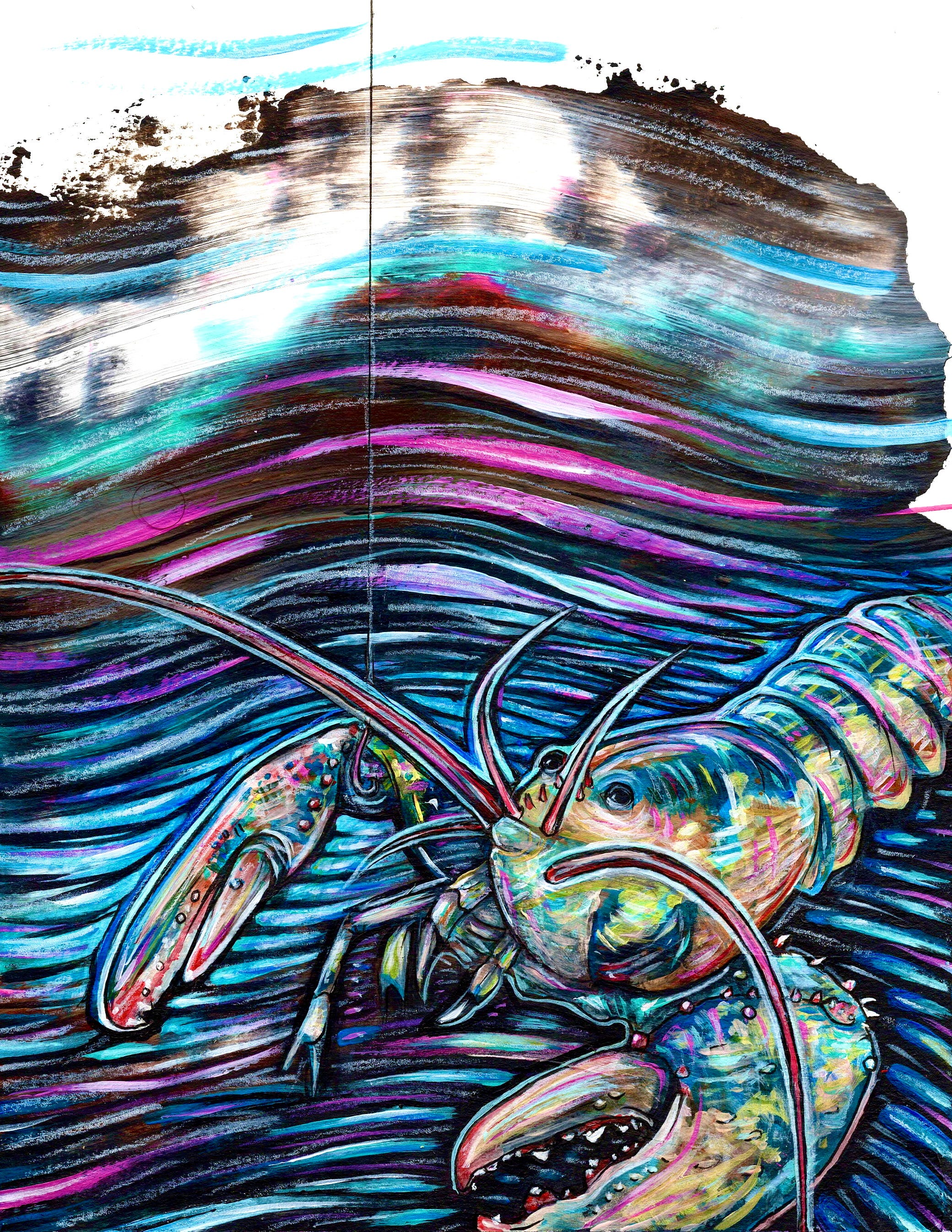
This story is from my very own brother Matt Robertson. He wrote it about his time in the late nineties working on a lobster boat. Without further adieu:
We Were Men of the Sea, After All
The world was a different place in 1998. Google was founded that year, Apple released the first iMac, postage stamps were 32 cents and gasoline a buck fifteen. Harrison Ford was People‘s Sexiest Man Alive. Cher introduced Auto-Tune to the world with her comeback single “Believe,” and lobsters were still hanging around the waters of southern New England in large numbers.
I was working as a deckhand that summer on a lobster boat in Connecticut. Actually, I’d begun the summer as a fry cook at a mall in Wisconsin, bored and rudderless and living at home, but then an old buddy called me up and said the boat he was working on needed a deckhand — the last guy methed out and went AWOL. Was I interested? Absolutely.
It was a family-run lobster operation out West Cove in the picturesque fishing village of Noank. I worked for Captain George “Chief” Main — a fourth generation lobsterman — and his son Tige (short for Tiger, nickname for George II). Chief lived with his wife Nancy in a sturdy, weather-beaten old house with cedar shingles turned silvery grey from decades of salt air. It was the same house they’d raised Tige and his sister in. Their driveway led down to the cove and their dock, where they kept their two 42-foot boats tied up.
Both boats were crewed by three guys: the captain, the gaffer, and the deckhand. I worked mainly with Chief and the gaffer Eddie, while over on Tige’s boat, my buddy Jon gaffed and Eddie’s brother Sparky deckhanded. There were two other guys who rotated in at times, Kevin and Odie.
We lobstered an area of the Long Island Sound known as “The Race,” a turbulent, three-mile-wide deepwater tidal channel where the Long Island Sound meets the Block Island Sound. The tides there were fast and furious. Our day trips out to The Race to haul lobsters (aka “bugs”) were timed with slack tides, which are brief windows in the tidal cycle when the horizontal movement of water stops completely before reversing direction. Our buoys would surface during this window, and the race would be on to empty as many traps as we could before the buoys disappeared again beneath the tidal flood.
We worked two separate slack tides per day, returning to shore in between to offload the haul and prep for the next tide. The work was by turns awesome, grueling, and hazardous. Ten hour days, six days a week, rain or shine. The money was good for 1998. I made ten an hour, nearly double my wage back home manning the fryer.
Since we timed our trips with the tides (which shift forward daily), work could begin as early as 4 a.m. Jon and I would roll up to the docks half asleep in his little blue hatchback (aka “The Mirthmobile”). Our first task was to load bait onto the boats, often in the dark. The bait was straight-up rotten fish, no way to sugarcoat it. We stored it in totes in the dockside cooler, and it was easily the worst smell in the world to wake up to.
Chief would have Dunkin’ Donuts coffees waiting for us on the boat, which we’d sip quietly during the 30 minute ride out to The Race. This was our chance to shake the cobwebs from our heads, maybe read a book or just watch the sun rise over the Atlantic. Then came the starting gun.
Here’s how it went: we’d pull up to our fishing grounds just as our buoys were starting to surface. One set of traps + rope + buoys is called a “trawl.” Our trawls consisted of four traps spaced evenly apart by about twenty/thirty feet of sinking groundline, connected to ~250 feet of vertical mainline which led up to a set of buoys on the surface. The outermost buoy functions as the flag buoy, designed for visibility to the naked eye. The inner buoy is what the captain maneuvers the boat up to while the gaffer leans out and hooks it. The gaffer then hoists the mainline up into a hydraulic winch (called the “hauler”), which hangs from a steel beam that is mounted to the rail of the boat, and is controlled by a lever that the captain operates. The hauler winches up the mainline while the gaffer coils the rope onto the deck. When the first trap appears, the captain stops the hauler while the gaffer pulls the trap onto the rail, opens the lid, dumps the old bait overboard, and passes the trap along the rail back to the deckhand.
My job then, as deckhand, was to clear the traps. Lobster traps are these big wire cages weighted with concrete bricks on the bottom. When clearing traps, time is of the essence. You don’t have time to think about whether you really want to reach your hand into a cage full of lobsters who’ve just been wrenched into an entirely alien world they never even knew existed.
Lobsters have two types of claws: the pincher, and the crusher. Both suck, but the crusher really sucks. No matter how good you get at handling lobsters, one always comes out of nowhere and latches on. When that happens there isn’t time to run around the deck hollering like a Looney Tunes character, so you just keep clearing traps with it on there man. Eventually it’ll let go. You could break the claw off, but that’s cruel plus it reduces the wholesale value.
Once you’ve cleared a trap, you add fresh bait, shut the lid, and slide it back along the rail to make room for the next one. When all four traps were on the rail and cleared, the captain would drive full steam ahead to the drop point, which he determined based on an indecipherable dry-erase methodology that a deckhand didn’t need to understand. All I knew was that when he gave the signal — still at full steam ahead — I would shove the four traps overboard sequentially, starting with the last one. Then the gaffer would toss the coils overboard, then the buoys. And with that we were on to the next trawl.
You’re doing all this mind you on a slippery open deck. You get your sea legs quick, and a sense for where to stand throughout the process, how to step around the coils of rope that could drag you under if a trap fell overboard at the wrong moment. Classic rock is blasting through the speakers the entire time, with looping ads for car dealerships and casino shows featuring washed up veteran rockers (Loverboy is coming to Foxwoods!).
There was never really any downtime out there. Between trawls, you and the gaffer are sorting through the catch, tossing softshells and eggbearing females overboard, measuring the smaller bugs with a gauge and tossing them overboard too if they didn’t make the grade. Then you band the claws of the keepers with a special tool and drop them into a big on-deck holding tank.
When we returned to shore after the morning tide, we’d unload the bugs into an even bigger holding tank on the dock, to cool their heels until after the second tide, when Chief or Tige would drive them to Abbot’s Wholesale to sell. There was then a three-ish hour “break” between tides, during which we’d grab sandwiches and Mountain Dews from the general store before getting back down to the dock for the worst-but-also-best part of the job: stringing bait.
Stringing bait was nasty business. Two solid hours of standing on the dock in the midday sun in your rubber boots and coveralls, grabbing rotten fish from a 55-gallon bait drum. Lobsters go for oily, rancid fish. We used whole skate plus bluefish carcasses from local charter boats. With a special kind of poker, you’d kebab four or five of them through the eyes, then notch a piece of string onto the end of the poker and pull it through, tying the ends together into a ring. We’d pile these bait rings into bins and load them onto the boats for the afternoon tide, and if we worked fast enough we’d have enough bait put aside for the morning tide as well — otherwise we’d have to come in absurdly early to string bait.
So the smell was brutal, and seagulls screeched and swarmed and shat all around you. You’d wear rubber gloves to protect your hands, but spines from the bait would pierce through and you’d develop these painful infections that salt and slime were constantly aggravating. “Fish hands,” we called them, and we all had them to varying degrees.
But it was the conversation on the dock that kept you going. Everyone was hilarious. It always put a little wind in our sails when Kevin and Odie were around. Those two had more stories than they could have possibly lived. Two hour bait shifts would fly by. Kevin was a ~40 year old semi-retired dead ringer for Tom Selleck. He’d made some wise investments early on and was learning Spanish so he could move somewhere cheap in South America and work even less. Odie was in his 20s, a freewheeling wanderer who spent his summers between Noank and a girlfriend’s place out on Long Island, which he would drive to in his pickup truck with a mattress set up under the topper for those inevitable nights when she kicked his ass out.
Chief didn’t string bait with us. He had plenty of higher order business to attend to as the brains of our operation (Tige too). For a man Chief’s age, his strength was the stuff of legends, like the time he deadlifted a 500 pound bait drum in a Hulk-like rage when it fell off a forklift. He could lose his temper for sure, but it was never for anything irrational. If he was angry, it was for good reason, and it only seemed to sharpen his awareness of the situation. He was a good man in a tight spot in other words, wise in a way that made it easy to trust him with your life — exactly what you’re looking for in a sea captain.
I’ll never forget the day we were pulled up alongside another lobster boat in The Race, trying to untangle our trawls. These were tense enough encounters on a calm day, tempers flaring between the captains over whose fault it was, who was wasting whose time — and money. Thousands worth of gear were on the line, literally.
That day though the sea was rough and the boats were rocking wildly. We were spaced just a few feet apart, rails parallel to each other, haulers screaming against the tension of the tangled lines. The captains were mad mad mad. One of the ropes snapped. The boats lurched and started drifting. The other boat’s hauler, along with its steel support beam, started rocking back towards my head as I stood by the rail watching on, oblivious, pondering the singular feeling of despair that comes with watching something sink out of sight forever, as when a child forgets to hang on to their helium balloon. “MATT GET BACK GET BACK,” Chief shouted. I jumped back just in time, otherwise I would have been returning to college that fall with a crushed skull. Not sure I ever thanked him for the heads up.
Chief had a patented move, which Jon branded the “Pinch-Twist-Shoulder-Shrug-Grin.” Whenever he finished razzing you for something, he’d pinch your shoulder and twist, but with crusher-claw force. Then he’d grin at you and shrug.
___
During one of these marathon baiting sessions someone got it in their head that there were tuna swimming around out there that we could sell for thousands of dollars. Your average recreational fisherman wouldn’t have the connections to sell a thousand dollar tuna, but we figured we probably did. And we had all the bait in the world. It felt like a sure bet. We’d blown enough of our wages that summer at the casinos and strip clubs across the border in Rhode Island, so we could stand to make some real money. Tige supported the plan, and on one of our rare days off we took a boat and some sea-fishing rods out to a spot offshore where rumor had it the tuna were biting.
We were out there for a couple of beery hours with nary a nibble, the dollar signs fading from our eyes. I’m not sure any of us had a clear strategy — where to cast, what to do with a hundred pound tube of furious muscle if we actually caught one, etc. We’d manage of course; we were men of the sea, after all. But I don’t think we were doing any of it right, simply dropping our baited hooks to the bottom, which in retrospect doesn’t make any sense since tuna tend to hang out somewhere in the middle of the water column.
We all caught exactly nothing — except Jon. Jon got something on his line. It was clearly not a tuna, but at least there was something on there. It meant we might not be returning to shore empty-handed, that we might have something to tell the theoretical ladies about at the bar later on.
The suspense just kept going, since he’d paid out hundreds of feet of line. Finally the hook breached the surface and he had… a lobster. No joke. He’d somehow managed to snag the thing by the elbow. It was unbelievable. The kicker was, it was too small to keep! We gauged it and had to throw it back.
___
In hindsight, that snagged lobster seems emblematic of a troubling new development in the fabled history of New England lobstering. It turns out these were the waning years of commercial lobstering in Connecticut. I remember Chief worrying about how few bugs we were landing compared with previous years, and he was right to worry.
What was happening was that sea temperatures were rising, and the population’s center of productivity was shifting northward and offshore. From 1998 to 2014, lobster landings in Connecticut fell by over 95%.1 Rhode Island’s fishery crashed too.2 Massachusetts and New Hampshire have been on the decline in recent years. Now, in 2026, the majority of commercial lobstering in the US is taking place in Maine, but as the Gulf of Maine continues to warm (which it is, very rapidly3), you have to wonder if the great American lobster — Homarus americanus — will just bug out of America altogether.
Last I heard, Chief and Tige were making ends meet with surveying and film jobs, since the open decks of lobster boats are ideal for that kind of equipment. Their boats were used to film scenes from Mystic Pizza and The Thomas Crown Affair. But that was ages ago. I wonder how they’re doing now.
All those guys for that matter, I wonder how they’re doing. Those were wild times.
1 https://www.climate.gov/news-features/climate-and/climate-lobsters
2 https://www.boston.com/news/local-news/2018/01/22/lobster-catch-new-england/
3 https://now.tufts.edu/2025/07/31/gulf-maine-warming-faster-pretty-much-anywhere-else